Bad Check Program Packet

MOHAVE COUNTY ATTORNEY

BAD CHECK PROGRAM

Branch Offices:

Bullhead City -(928) 758-0727
Lake Havasu City - (928) 854-3501

MATTHEW J. SMITH
P.O. Box 7000 County Attorney
700 W. Beale Street
Kingman AZ 86402-7000
Telephone (928) 753-0770
Fax (928) 753-4290

JAMES J. ZACK
Chief Deputy

MATTHEW J. SMITH Branch Offices:
P.O. Box 7000 County Attorney Bullhead City - (928) 758-0727
700 W. Beale Street Lake Havasu City - (928) 854-3501
Kingman AZ 86402-7000 JAMES J. ZACK
Telephone (928) 753-0770 Chief Deputy
Fax (928) 753-4290

TO THE PEOPLE OF MOHAVE COUNTY

The writing of bad checks is an ever-increasing problem in our County. Citizens and merchants in the County lose thousands of dollars every year as a result of bad checks. The rest of us suffer as well, because businesses are forced to raise their prices in order to offset losses from bad checks. Nationwide statistics show that bad checks, a form of retail theft, are one of the major contributors to retail bankruptcies. Writing bad checks is against the law, especially in cases in which the writer of the check does not reimburse the merchant for the check immediately. The Mohave County Attorney’s Office Bad Check Program is dedicated to protecting merchants and businesses from those who commit theft by bad check writing.

The purpose of this Bad Check Handbook is to explain the procedures currently being used in this County to reduce bad check writing and enforce Arizona’s Bad Check Law that went into effect on August 4, 1984. Lori Wills-Pietz has been operating this program for over 12 years, and is dedicated to insuring that victims are made whole again. Her goal, and the goal of the Bad Check Program, is to engage in a comprehensive program to eliminate bad check writing. This program includes procedures to warn offenders, prosecute people who do not respond to the warnings, and collect and remit restitution to merchants and other victims of bad checks.

It is my hope that by working together to solve this serious problem, we can make a serious dent in the epidemic of bad check writing. The more we work together and cooperate, the more successful we will be. I urge you to become heavily involved in our efforts to help eliminate the bad check problem in Mohave County. Thank you for your help and support.

MATTHEW J. SMITH
MOHAVE COUNTY ATTORNEY

Bad Check Program Information

Each day thousands of checks are written to pay for goods and services. Hundreds of checks are not honored when presented to the bank. Hard working merchants and others go unpaid, who become the victims of bad check crimes.

Arizona has become the #1 State in the United States for ID Theft for the second year in a row (2004 and 2005). This is not something we are proud of. State Law is the primary enforcement tool for businesses and individual victims. Criminal provisions are designed to protect the innocent bad check victims and these laws mandate recovery of restitution against bad check writers.

The law makes "Issuing a Bad Check” a Class 1 Misdemeanor, with repeated violations and high dollar amounts resulting in Felony prosecution. When a check is returned unpaid, you (the victim/merchant) need to notify the bad check writer in writing that the check was returned for non-payment. THIS IS ACCORDING TO ARIZONA LAW. The check writer must reimburse you for the total amount of the check within time limits established by law. Thereafter, the check writer may be subject to criminal prosecution by the Mohave County Attorney’s Office.

The Mohave County Attorney’s Office established the Bad Check Program to assist victims/merchants. The primary responsibility of the program is to recover restitution monies for you. Most “first time” bad check writers will be provided an opportunity to avoid prosecution by payment of full restitution and statutory fees which is referred to as the “diversion” process. If the check writer does not make full restitution, and if sufficient evidence for criminal charges is available, criminal prosecution will be initiated.

This Handbook provides valuable information on reducing and eliminating losses due to bad checks. The Mohave County Attorney’s Office created specific procedures for victims/merchants accepting checks to follow, minimizing exposure to bad checks and providing evidence against the check writer. This guidebook provides directions for processing bad checks and supporting the prosecution of bad check writers. Please read this guidebook carefully and follow the instructions.

In addition to this handbook, the Bad Check Program Coordinator is available to provide free training to victims/merchants on check acceptance procedures and forgery detection. Training of your employees should assist in reducing the high costs of bad check writers. With the proper trained employees, this is your first step in fighting the bad check writers. The training only works when the managers/owners support the Bad Check Program process.

The Mohave County Attorney’s Office Bad Check Program is mandated to work with victims/merchants in identifying bad check crimes and quickly enforcing full restitution for victims of these crimes. Together, significant reductions in bad checks can be achieved.

Each day thousands of checks are written to pay for goods and services. Hundreds of checks are not honored when presented to the bank. Hard working merchants and others go unpaid, who become the victims of bad check crimes.

Arizona has become the #1 State in the United States for 10 Theft for the second year in a row (2004 and 2005). This is not something we are proud of. State Law is the primary enforcement tool for businesses and individual victims. Criminal provisions are designed to protect the innocent bad check victims and these laws mandate recovery of restitution against bad check writers.

The law makes "Issuing a Bad Check" a Class 1 Misdemeanor, with repeated violations and high dollar amounts resulting in Felony prosecution. When a check is returned unpaid, you (the victim/merchant) need to notify the bad check writer in writing that the check was returned for non-payment. THIS IS ACCORDING TO ARIZONA LAW. The check writer must reimburse you for the total amount of the check within time limits established by law. Thereafter, the check writer may be subject to criminal prosecution by the Mohave County Attorney's Office.

The Mohave County Attorney's Office established the Bad Check Program to assist victims/merchants. The primary responsibility of the program is to recover restitution monies for you. Most "first time" bad check writers will be provided an opportunity to avoid prosecution by payment of full restitution and statutory fees which is referred to as the "diversion" process. If the check writer does not make full restitution, and if sufficient evidence for criminal charges is available, criminal prosecution will be initiated.

This Handbook provides valuable information on reducing and eliminating losses due to bad checks. The Mohave County Attorney's Office created specific procedures for victims/merchants accepting checks to follow, minimizing exposure to bad checks and providing evidence against the check writer. This guidebook provides directions for processing bad checks and supporting the prosecution of bad check writers. Please read this guidebook carefully and follow the instructions.

In addition to this handbook, the Bad Check Program Coordinator is available to provide free training to victims/merchants on check acceptance procedures and forgery detection. Training of your employees should assist in reducing the high costs of bad check writers. With the proper trained employees, this is your first step in fighting the bad check writers. The training only works when the managers/owners support the Bad Check Program process.

The Mohave County Attorney's Office Bad Check Program is mandated to work with victims/merchants in identifying bad check crimes and quickly enforcing full restitution for victims of these crimes. Together, significant reductions in bad checks can be achieved.

Welcome to the Bad Check Program

This is our Bad Check Handbook for your use in submitting checks to our program. We hope that you will take the time to review the handbook and adhere to our policies and procedures. This will speed the process of collecting on your bad checks.

Beginning January 1, 2006, we will also attempt collection of a $25.00 victim fee per each check writer, in addition to this service being provided to you at no charge.

DO NOT ACCEPT ANY PAYMENTS FROM THE CHECK WRITER AFTER YOU HAVE SUBMITED IT TO THE PROGRAM.

Refer the check writer to the County Attorney to pay. This is the only way the program will work. If you do accept restitution from anyone other than the County Attorney, you are undermining the deterrent effect of the Bad Check Program which must be maintained. The Bad Check Program will not process future bad checks for your business if you take payment after submission to the program. You may also be liable for a collection fee due to the Bad Check Program.

Once the check is received in the program, we send an "official" Notice of Dishonored Check to the check writer. Under Arizona law, time limits have to pass before charges will be filed. Charges are filed only IF there is no other way to obtain the money for you on the check. If there is no response when the charges are filed, a warrant will be issued by the Court.

Finally, we ask that you please be patient with our program. When the County Attorney receives payment on your bad check it is sent to you within 10 business days. Please feel free to contact us if you have any questions.

SEE NOTICE OF DISHONORED CHECK IN APPENDIX
SEE SUBMISSION FORM IN APPENDIX

How to Submit Checks to the Bad Check Program

  1. According to Arizona law YOU must send a certified letter to the check writer as soon as the check is returned from your bank.
    You may use the form in the appendix titled: "Notice of Dishonored Check”, or write your own using ours as a guide. The law states you allow them 12 days plus 5 days for mailing to respond to your letter (17 days).
    If there is no response or your letter is returned by the post office unclaimed/undeliverable within those 17 days, you do not have to wait the full 17 days and may proceed with submitting the check to the program.
  2. COPY the SUBMISSION FORM provided in the appendix of this handbook, completing the information in specific detail. The more information you give us the better the opportunity we have in collecting the funds for your bad check.
  3. STAPLE the ORIGINAL check to the form, enclose a copy of the Certified Letter you sent and mail to our office in Kingman, at:

    Bad Check Program
    Mohave County Attorney's Office
    P. O. Box 7000
    Kingman, Arizona 86402


    or hand deliver to:

    Bad Check Program
    Mohave County Administration Building
    700 West Beale St.
    Kingman, Arizona 86401

CHECKS NOT HANDLED BY BAD CHECK PROGRAM

THE FOLLOWING CHECKS CANNOT BE HANDLED BY THE BAD CHECK PROGRAM. MOST MUST BE PURSUED CIVILLY IN SMALL CLAIMS COURT OR BY A COLLECTION AGENCY. YOU ARE ADVISED TO SEEK PRIVATE LEGAL COUNSEL FOR ADVICE ON THESE PROCEDURES. HOWEVER, PLEASE CALL THE BAD CHECK PROGRAM ABOUT YOUR BAD CHECK, THE CIRCUMSTANCES INVOLVING YOUR CHECK MAY QUALIFY FOR THE PROGRAM REGARDLESS OF WHAT IS MENTIONED BELOW.

  • Checks not written or passed within Mohave County.
  • Online bill-pay checks. Since these checks are not witnessed by anyone when they are issued, we cannot prosecute. Besides not identifying the person issuing the check, we do not have any signature authorizing the check being issued.
  • Stale dated checks. A check must be presented to a financial institution for payment within 30 days of the date written on the face of the check.
  • Checks that are altered or suspected of being forgeries, counterfeit and checks stamped “Lost or Stolen” or “Counterfeit", should be immediately directed to local law enforcement, as these are probably the subject of a more serious crime like fraud, stolen or theft of checks or forgery.
  • Rent checks. Rent checks are not a criminal matter. Landlords are protected under the Residential Landlord and Tenant Act laws. The amount of the bad check plus any other amounts owed to you are recoverable in this civil procedure. Please refer to Landlord/Tenant Act Handbook available at your local Justice Court. You should seek private legal advice from an attorney.
  • Checks that are electronically processed by a third party company (i.e.: Telechek, Certigy, ChexSystems, Checkwrite, Crosscheck, SCAN, are a few of the companies). These companies should reimburse you for your loss, as that’s why you are paying for their service. If you are using any of these companies, and hand the actual paper check back to the check writer at the time of the sale, you are giving away our prosecution evidence. If you keep the original check in your possession, then forward it to the Bad Check Program once it’s returned from your bank.
  • Checks issued by an electronic or online internet service where the issuer was not present when the check was passed or when the check was not signed by the issuer. A witness is required to have seen who actually signed the check.
  • Checks that have been cashed at your business (two party checks), but are not made payable to your business, such as payroll checks issued to the person attempting to cash the check. This check is not payable to you, therefore, you should not be cashing the check. You are not a bank and you should never “cash” any checks for anyone. These cashed checks cannot be prosecuted by the Bad Check Program.
  • Post dated checks either from the date of acceptance, receipt or date of the check, as this is a civil agreement between you and the check issuer, because you know in advance the check writer does not have any money in his account. You take a risk in accepting these checks and for your own safety, you should not accept a post dated check. This becomes a civil matter because you were put on notice that the check writer had no funds in the bank when you accepted the check.
  • Stop payment checks whether there were sufficient funds on deposit to pay said checks or not, if payment was stopped after issuance we cannot prosecute.
  • Checks which the payee or holder knew that the check writer did not have funds to pay the check at the time the check was issued.
  • Checks issued in matters which constitute civil disputes (rent checks, checks for rental storage units, contract agreements, verbal agreements, personal loans, promissory notes, etc., (see also Residential Landlord and Tenant Act Handbook).
  • Checks redeemed by a guarantor or assigned by a payee to a guarantor.
  • Checks as to which the payee or holder has been expressly notified before the drawing of the check or has reason to believe that the check drawer did not have on deposit as to his credit with the drawee, sufficient funds to ensure payment on its presentation (IRS freezes, hold by insurance companies or hold by the bank). This is a statutory defense.
  • Checks as to which the insufficiency of funds results from an adjustment to the person's account by the credit institution without notice to the person from the banking institution.

WHEN YOU RECEIVE A CHECK

To safeguard against taking a bad check and as a prerequisite to the service of the Bad Check Program, be certain to do the following:

ALWAYS DEMAND IDENTIFICATION

  • PRIMARY IDENTIFICATION IS AN ARIZONA DRIVER'S LICENSE.
  • COMPARE NAME AND ADDRESS on the license to those on the check.
  • COMPARE SIGNATURE on the driver's license to person passing the check.
  • WRITE DOWN DATE OF BIRTH of the check writer.
  • Make sure the driver's license has not expired.
  • Military identification, if it has the date of birth, identification number, along with a picture.

 SOCIAL SECURITY CARDS ARE NOT PROPER IDENTIFICATION

RECORD ALL INFORMATION ON THE FRONT OF THE CHECK

  • The reason? During the check clearing process, many banks place inked stamps on the back of the check which could cover up your identification entries, plus any dates the check was entered for deposit.
  • Record your name or initials as receiver of the check.
  • A witness is required to successfully prosecute a criminal case. The witness must be a person who accepted the check. Be certain the clerk's identity can be determined from the face of the check.
  • The Driver's License number, home address and telephone number and any other identifying numbers or information you may happen to obtain on the check writer.

WHAT DO YOU LOOK FOR WHEN TAKING A CHECK?

Follow this simple checklist to reduce the possibility of accepting a bad check. Early detection eliminates many hardships that result from accepting a bad check. The preventive steps listed below should be utilized by you and your employees. These steps will reduce losses and increase the chances of full recovery.

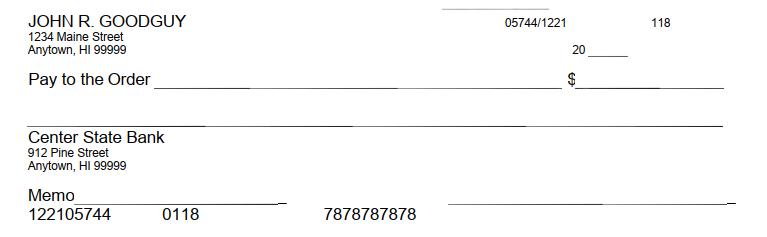
  • DOES IT HAVE A LOW CHECK NUMBER OR NO PRINTED CHECK NUMBER?
    About 90% of bad checks are drawn on accounts less than one year old. If check numbers are handwritten, or are lower than 125, start with 1000 or 1100, exercise caution.
  • IS THE DATE OF THE CHECK ACCURATE?
    This eliminates the possibility of receiving postdated checks (those dated in the future). If a check is post dated, it cannot be prosecuted.
  • VERIFY THAT IT IS NOT FORGED OR COUNTERFEIT.
    Arizona banks have Federal Reserved District numbers of "11" or "12", so check the first two digits of the nine-digit series at the lower left corner of the check, besides checking the denominator of the fraction at the upper right. If the check names an Arizona bank, but the two-digit number is not "11" or "12" you may have a forged or counterfeit check.

  • Special magnetic ink is used for automated check sorters. It has a dull finish. Check the numbers on the lower right of the check. If they shine or reflect light, it may be a forgery.
  • Look at the account number written in the center bottom of the check.
    Most account numbers do not have spaces. If there is a space between the numbers, this account number may have been altered.
  • More checks are now being made on home personal computers.
    If you received a check that looks "home-made", exercise EXTREME caution and obtain EXTRA identification from the check writer. Ask questions about address, phone number and driver's license information. Don't hesitate to call the bank for verification before you accept the check.
  • You will usually feel perforations on at least one edge of all legitimate personal checks. Most forgers use a regular paper cutter, leaving all four sides smooth.
  • Look at the obvious! Do the amounts match on the amount written in numbers to the amount written out in words?
  • Are the amounts altered? Check the numerals AND the words to see if they appear to be consistent with the other writing. If there is crowding, and if there is any contrast in ink color or density or if the words look like they have been erased. Any inconsistencies may suggest an alteration. Make certain that all parts of the check are easily read.
  • Has the name of the payee been changed or crossed out and your name written in? If the color density or writing of the name appears different, there may have been an alteration. If a check appears to be made payable to two or more payees and the second name appears in different color, density or writing from the first, there may have been an alteration.
  • If the check is made payable to someone else and not to you, DO NOT CASH IT. You can not get identification of the actual person who wrote the check if they are not the ones presenting the check issued to you.
  • If the check is made payable to someone else and not to you, DO NOT CASH IT. You can not get identification of the actual person who wrote the check if they are not the ones presenting the check issued to you.

IF STILL IN DOUBT, USE COMMON SENSE, AND DO NOT ACCEPT THE CHECK. ARIZONA LAW DOES NOT REQUIRE ANYONE TO ACCEPT CHECKS. YOU MAY LOSE THE SALE, BUT YOU WON'T LOSE YOUR MERCHANDISE.

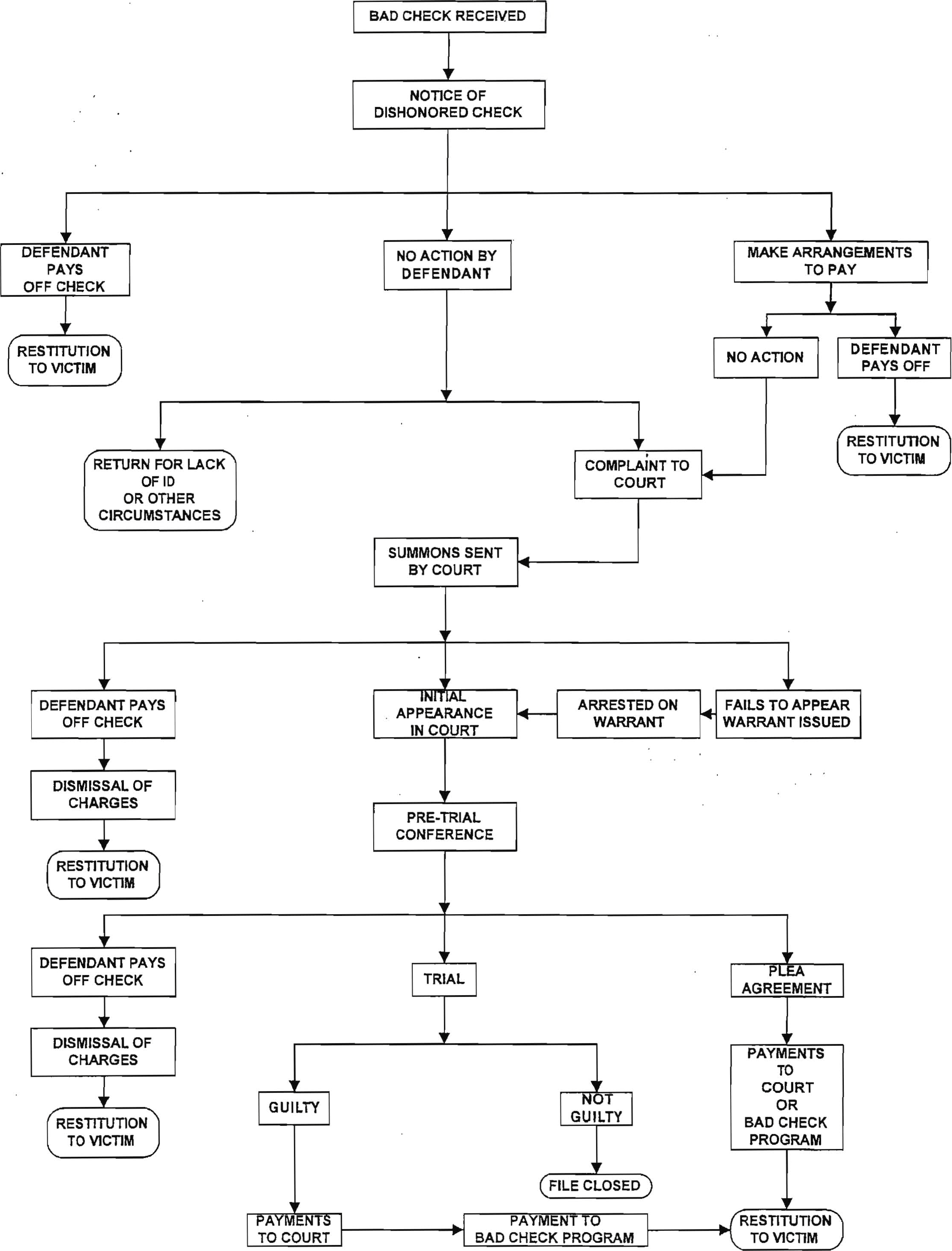
How Bad Checks Are Processed

flow chart

If your employees are accepting checks, help them out by posting your check cashing policies and review your policy with them. For example, if you require an Arizona Driver's License and one other identification, by posting that fact, you enable the employee to simply point out that policy and say, "I am sorry, but I am not permitted to accept your check without the listed identification". This depersonalizes the transaction between the customer and employee so that the employee cannot be intimidated into accepting the check.

Share your knowledge about bad checks with your employees and co-workers. Talk about the problems and solutions on a regular basis and review your policies so they all know what to do when accepting a check.

Some small companies and businesses maintain and share a "bad check list" which names those individuals who have written bad checks. While our bad check program will assist you in recouping your losses, it is still an inconvenience to get involved in the collection process. You are the best protection against bad checks.

Don't accept checks for more than the amount of purchase (or give cash back) or made payable to someone else (mostly payroll checks). You are a business, not a bank. If you feel that good customer relations would warrant cashing these checks anyway, keep a list of your good customers and provide this service for them only, with proper identification obtained. The Bad Check Program cannot collect these checks for you.

It is not a good idea to accept checks from persons who are obviously under the influence of drugs or alcohol without requiring solid identification. These checks could be cashed with no purchase from your store, which is not good business for you.

Do not accept checks that may be issued by a third party who asked you to cash the check for them. For example, If John Smith issued a check to Mary Jones, and Mary Jones asks you, the cashier/merchant, to cash John's check for her, DO NOT CASH IT. The reasons are twofold. (1) Because you need to obtain identification of John Smith who actually issued the check, not Mary Jones, to whom you are giving the money and (2) you did not actually witness John signing the check. This is not a good practice on behalf of your business to cash these checks. Exercise extreme caution and see the signs of a possible situation before accepting the check.

Many businesses have now opted to use the debit card system in their stores that eliminate the taking of checks altogether. This is a very good idea as the information deals directly with the bank and the check writer's account. If you do not wish to accept the check, tell them so, and suggest that they use their debit card instead (also referred to as "electronic funds transfers" or EFT's). If they refuse, there's the possibility that the check is also not good.